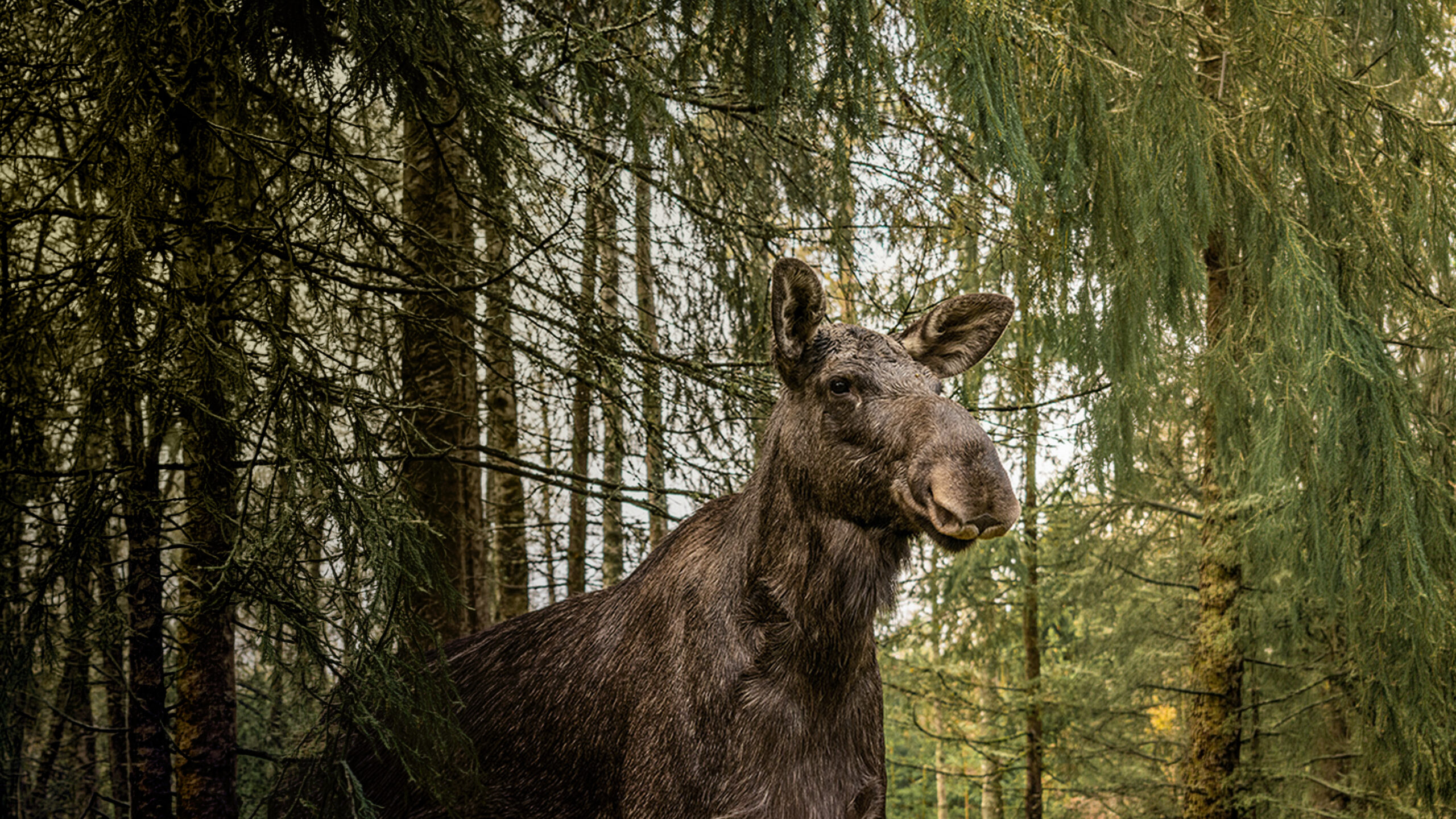
(European moose; Alces alces) The moose is our country’s largest land mammal. It is found throughout the country except on Gotland. Over the past 20-30 years, the moose population has increased very sharply, and today we have a population of approximately 300,000 animals. There are several reasons for this increase, but hunting regulations and more abundant grazing due to new forestry methods (clear-cutting) are the primary ones. Bull moose have their largest antlers at 7-10 years of age, when they are considered ‘prime’. After this, the antlers decrease in size again and are then called ‘return’ (retur). There are two types of antlers: palmate antlers (skovelhorn) and cervine antlers (stånghorn).
Quick facts about Moose
- Order
- Order Artiodactyla (Even-toed ungulates)
- Family
- Deer (Cervidae)
- Weight
- Between 320-450 kg (bulls) In extreme cases up to 800 kg Between 275-375 kg (cows)
- Lifespan
- Up to 25 years
- Mating season
- September-October
- Gestation
- approx. 8 months
- Young
- Born in May-June and weigh 8-15 kg at birth: usually 1 or 2 calves, which suckle for 7-8 months.






Our Mission
More and more animal species around the world are threatened with extinction, and the list of species at risk of disappearing continues to grow. The conservation of threatened species is now a shared responsibility for zoos around the world. Our aim is to create greater understanding of the irreplaceable value of nature and biodiversity. Through research, we learn more about the animals, giving us greater opportunities in our work to conserve endangered species. Our three most important missions as a zoo are: conservation, education and research.